Most enterprise AI companies are selling a dashboard with an LLM behind it. They call it “AI-powered” because they bolted GPT onto a CRUD app. The actual intelligence layer — the part that reasons, learns, and improves without human intervention — doesn't exist. They skipped it.
Avyay (अव्यय — “the imperishable”) exists because we believe enterprise software is about to undergo its most fundamental transformation since cloud computing. Not incremental — structural. The entire relationship between organizations and their software is inverting: instead of humans operating tools, autonomous systems will operate themselves while humans provide intent.
This is our Year One vision. Not a press release full of vague ambitions. A concrete thesis about where the enterprise AI market is going, what we're building to get there, and how we plan to win in a market that's growing faster than most teams can hire.
The Autonomous Software Thesis

Enterprise software has gone through three eras. The first was on-premise — you bought a license, installed it on a server, and hired a team to maintain it. The second was SaaS — you rented the same software from someone else's server. Both eras share the same fundamental assumption: software is a tool that humans operate.
The third era inverts this. Autonomous software isn't a tool you operate — it's a system that operates itself. You provide goals, constraints, and feedback. The software figures out the execution.
The shift isn't from “manual” to “automated.” It's from “deterministic workflows” to “goal-seeking agents.” The difference is that automated workflows break when inputs change. Goal-seeking agents adapt.
This isn't speculative. We're already running Avyay this way. Our build pipeline generates, prioritizes, and executes development tasks autonomously — 24 hours a day, across distributed nodes. Our content engine researches, writes, and publishes technical blog posts without human intervention. Our stock advisor scans markets, applies quantitative screens, and delivers recommendations before the market opens.
We're not building tools for other companies to use. We're building the autonomous systems internally first, proving they work, and then packaging them for enterprises that want the same capabilities.
Why Now?
Three converging forces make this the right moment:
- LLM capability has crossed the reasoning threshold. GPT-4, Claude, and Gemini can now handle multi-step reasoning, code generation, and complex analysis at a level that makes autonomous task execution viable — not perfect, but viable enough to be useful at scale.
- Agent frameworks are maturing rapidly. The tooling for building, orchestrating, and monitoring AI agents has gone from research projects to production-grade infrastructure in under 18 months. OpenClaw, LangGraph, CrewAI, and similar frameworks have made agent orchestration accessible.
- Enterprise tolerance for AI has shifted from skepticism to urgency.Companies that were cautious in 2024 are now racing to adopt. McKinsey's 2025 survey found that 72% of enterprises have deployed AI in at least one business function, up from 55% the prior year. The market isn't asking “should we use AI?” anymore. It's asking “why isn't our AI doing more?”
The Five Pillars of Avyay

Avyay isn't a single product. It's an integrated platform built on five pillars — each named in Sanskrit to reflect our philosophy that intelligence, like the word अव्यय itself, should be imperishable.
Knowledge — The Second Brain
Enterprise knowledge decays. Wikis go stale. Documents contradict each other. New hires spend months learning what the organization already knows but can't surface.
VIDYĀ is a knowledge graph engine that ingests documents, conversations, and operational data, then resolves entities, scores trust, detects contradictions, and enables multi-hop retrieval. Unlike vanilla RAG systems that treat every document as equally trustworthy and every chunk as independent, VIDYĀ understands relationships between concepts and confidence levels across sources.
Year One target: Ship a hosted Second Brain platform with trust scoring, entity resolution, and contradiction detection. Support 10M+ entities per tenant. Integration with Confluence, Notion, Google Drive, and Slack.
Agents — OpenClaw Enterprise
AI agents are only as good as their orchestration. Most agent frameworks give you building blocks but no production infrastructure — no observability, no guardrails, no fleet management, no cost controls.
KARMA is our enterprise agent platform built on OpenClaw. It handles multi-agent orchestration, tool authorization, session management, and audit logging. Agents can be deployed across distributed nodes, monitored in real-time, and governed with fine-grained permission policies.
Year One target: Production-grade multi-agent orchestration with role-based access control, cost attribution per agent, and SOC 2 Type II compliance. Support for hybrid deployment (cloud + on-premise nodes).
Analytics — Intelligence That Compounds
Traditional analytics tells you what happened. JÑĀNA tells you what it means, what's changing, and what you should do about it. It's analytics that reasons — combining structured metrics with unstructured context from your knowledge graph to generate insights that pure data pipelines miss.
Think of it as the difference between a dashboard that shows “revenue dropped 12%” and a system that says “revenue dropped 12% because three enterprise accounts paused renewals after the pricing change in March — here's what they said in their last QBR calls and the pattern matches two other churn signals from Q3.”
Year One target: Anomaly detection with natural language explanations. KG-enhanced root cause analysis. Automated report generation that synthesizes metrics + context.
Copilot — Context-Aware Assistance
Every enterprise is deploying copilots. Most of them are glorified autocomplete — they generate text based on the immediate prompt with no awareness of the organization's knowledge, decisions, or context.
VĀNI is different because it's backed by VIDYĀ (the knowledge graph) and JÑĀNA (the analytics engine). When a sales engineer asks “what's the competitor landscape for this deal?”, VĀNI doesn't generate generic platitudes. It pulls competitive intelligence from ingested win/loss reports, cross-references CRM data, and surfaces relevant case studies — with trust scores on every source.
Year One target: Copilot SDK that connects to VIDYĀ for knowledge grounding. Integrations with Slack, Teams, and email. Per-team customization with fine-tuned retrieval scopes.
Governance — Trust, Safety, and Compliance
Enterprise AI without governance is a liability. Every agent action needs to be auditable. Every knowledge source needs a trust score. Every output needs a confidence level. And every deployment needs to comply with the organization's security policies.
DHARMA is the governance layer that wraps around everything else. It provides permission policies for agent actions, audit trails for every decision, data classification for knowledge sources, and compliance frameworks for regulated industries.
Year One target: Complete audit logging across all pillars. Role-based access control with attribute-based overrides. SOC 2 Type II certification. GDPR and HIPAA compliance tooling.
Target Market: Who We're Building For
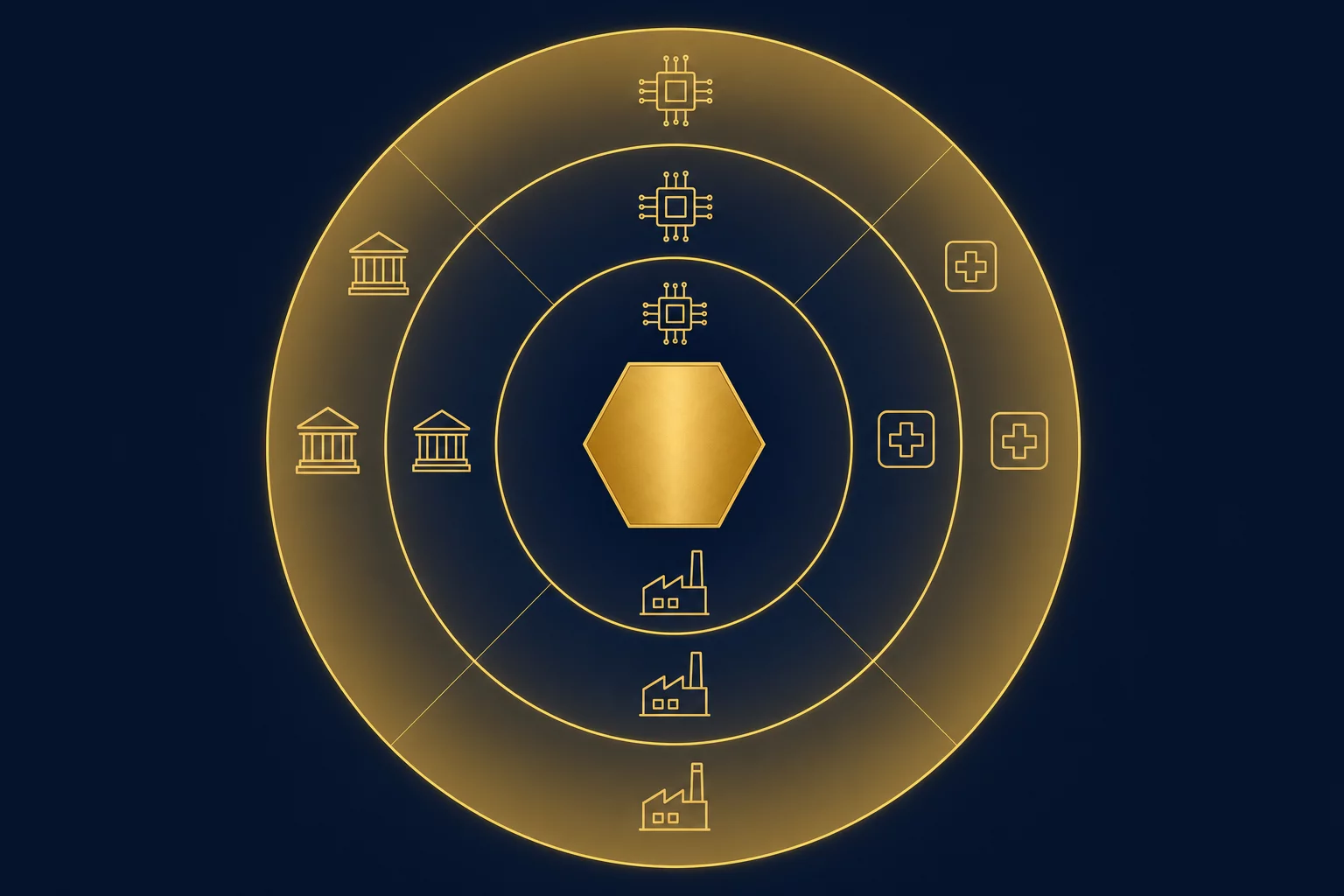
The enterprise AI market will exceed $300 billion by 2028. But “enterprise AI” is too broad to be useful as a target. We're focusing on three specific segments in Year One, expanding outward as the platform matures.
Segment 1: Mid-Market Tech Companies (200–2,000 employees)
These companies have the technical sophistication to adopt AI agents but lack the resources to build the infrastructure from scratch. They're running 5–15 SaaS tools, drowning in operational data, and losing institutional knowledge every time someone leaves. They need a knowledge graph that plugs into their existing stack and agents that actually do things — not another dashboard.
Entry point: VIDYĀ (Second Brain) for knowledge management → expand to KARMA (agents) for workflow automation → layer VĀNI (copilot) for team productivity.
Segment 2: Professional Services and Consulting Firms
Consulting firms are knowledge businesses that operate on remarkably fragile knowledge infrastructure. Client insights sit in individual consultants' heads. Project learnings get filed in SharePoint and never found again. Proposal generation is manual and repetitive.
Entry point: VIDYĀ for institutional knowledge capture → VĀNI for proposal and analysis generation → JÑĀNA for client intelligence and pattern detection across engagements.
Segment 3: DevOps and SRE Teams
Incident response is a natural fit for autonomous agents. When a production system breaks at 3 AM, you need a system that can correlate alerts, search logs, check recent deployments, and propose a fix — without waiting for a bleary-eyed engineer to context-switch from sleep to debugging.
Entry point: KARMA agents for automated incident triage → VIDYĀ for runbook knowledge → JÑĀNA for anomaly detection and root cause analysis.
Competitive Positioning: What We Do Differently
The enterprise AI landscape is crowded but shallow. Here's how the field breaks down and where Avyay sits.
| Category | Players | Gap |
|---|---|---|
| LLM-as-a-Service | OpenAI, Anthropic, Google | Raw models, no enterprise context or orchestration |
| RAG Platforms | Pinecone, Weaviate, Zilliz | Vector search without entity resolution or trust scoring |
| Agent Frameworks | LangChain, CrewAI, AutoGen | Developer tools, not production platforms with governance |
| Enterprise AI Suites | Salesforce Einstein, Microsoft Copilot | Locked to their ecosystem, surface-level intelligence |
| Copilot Startups | Glean, Guru, Moveworks | Search-based, no autonomous capabilities |
Avyay's Differentiation
We occupy the intersection that nobody else does: knowledge graph + agent orchestration + governance, integrated as a single platform.
- Knowledge-grounded agents.Our agents don't just call LLMs. They reason over your knowledge graph. Every agent action is informed by organizational context — past decisions, domain expertise, entity relationships — not just the immediate prompt.
- Trust-scored everything.Every piece of knowledge has a trust score. Every agent output has a confidence level. Every recommendation cites its sources with provenance. This isn't a feature — it's an architectural principle. Enterprises won't adopt AI they can't verify.
- Dogfooded infrastructure.We run Avyay to build Avyay. Our autonomous build pipeline, content engine, and market analysis tools are all production instances of the same platform we're selling. This means bugs surface in our own workflow before they reach customers.
- Hybrid deployment. Most enterprise AI platforms are cloud-only. We support cloud + on-premise nodes via OpenClaw. Sensitive data stays on your infrastructure. Agent execution can happen locally. This matters for regulated industries.
What Most People Miss
The biggest misconception in enterprise AI right now is that the model is the moat.It isn't. Models are commoditizing fast. GPT-4 level capability that cost $30/million tokens in early 2024 costs under $1 today through open-weight alternatives. By late 2026, frontier-level reasoning will be effectively free for most workloads.
The real moat is organizational context.The knowledge graph that encodes your company's decisions, relationships, and institutional memory. The trust scores that reflect years of operational learning. The agent workflows that embody your team's processes. None of that transfers when you switch LLM providers. All of it becomes more valuable over time.
This is why we named the company Avyay — अव्यय — “that which does not decay.” The intelligence layer we're building is designed to compound. Every interaction improves the knowledge graph. Every agent execution refines the workflow. Every correction updates the trust scores. The system gets smarter with use, not stale with time.
In Year One, we don't need to be the largest platform. We need to be the one that enterprises trust enough to feed their organizational knowledge — because once that knowledge graph exists and compounds, switching costs become infinite.
Year One Execution: Quarters and Milestones
Vision without execution is poetry. Here's the concrete plan.
YEAR ONE ROADMAP
═══════════════════════════════════════════════════════

Q3 2026 (NOW → August)
├── VIDYĀ: Second Brain hosted beta
│   ├── Trust-scored entity resolution
│   ├── Multi-source ingestion (Confluence, Notion, Drive)
│   └── Contradiction detection engine
├── KARMA: OpenClaw Enterprise alpha
│   ├── Multi-agent orchestration
│   ├── Tool authorization framework
│   └── Session management + audit logging
└── Foundation
    ├── SOC 2 Type II audit initiated
    ├── 5 design partners onboarded
    └── Content engine: 60+ published articles

Q4 2026 (September → November)
├── VIDYĀ: GA release
│   ├── 10M+ entity support per tenant
│   ├── Multi-hop graph queries
│   └── Slack + Teams integration
├── KARMA: Enterprise beta
│   ├── RBAC + cost attribution
│   ├── Hybrid deployment support
│   └── Agent observability dashboard
├── JÑĀNA: Analytics alpha
│   └── KG-enhanced anomaly detection
└── Revenue
    ├── First 10 paying customers
    ├── $200K ARR target
    └── Seed round closed

Q1 2027 (December → February)
├── VĀNI: Copilot beta
│   ├── KG-grounded responses
│   ├── Per-team retrieval scopes
│   └── SDK for custom integrations
├── DHARMA: Governance GA
│   ├── Complete audit trail
│   ├── GDPR + HIPAA tooling
│   └── SOC 2 Type II certified
└── Growth
    ├── 50 paying customers
    ├── $1M ARR target
    └── Series A preparation
Common Mistakes and Tradeoffs
Building an AI platform in 2026 comes with tradeoffs we're making deliberately:
- Depth over breadth.We're building five pillars but shipping them sequentially, not simultaneously. VIDYĀ first because knowledge is the foundation everything else builds on. Teams that try to ship everything at once ship nothing well.
- Dogfooding over selling.We're using Avyay to build Avyay before we sell it externally. This slows our go-to-market by ~3 months but means our first enterprise customers get battle-tested infrastructure, not a prototype.
- Knowledge graph over fine-tuning.Many competitors are fine-tuning models on customer data. We're building knowledge graphs instead. Fine-tuning is brittle (models get updated, training data becomes stale) and opaque (you can't inspect what the model “knows”). Knowledge graphs are durable, inspectable, and composable.
- Hybrid deployment adds complexity.Supporting both cloud and on-premise execution doubles our infrastructure work. We're doing it because regulated industries — healthcare, finance, defense — won't send sensitive data to a third-party cloud. This market is large and underserved.
- Small team by design.We're running with a 2-person team augmented by autonomous agents. This sounds like a limitation — it's actually our thesis in action. If we can't build a company with AI-augmented leverage, we have no business selling AI-augmented leverage to others.
Practical Takeaways
If you're evaluating the enterprise AI landscape — as a buyer, investor, or builder — here's what we think matters:
- Ask where the context lives.If the vendor's AI doesn't have a persistent knowledge layer, it's just a prompt-to-response pipe. Every interaction starts from zero. That's not intelligence — it's expensive autocomplete.
- Ask about trust and provenance.Can you see why the AI made a recommendation? Can you trace it to source documents with confidence scores? If not, you're deploying a black box in production.
- Ask about governance before capabilities.The fastest AI platform is worthless if you can't audit what it did, control who it talks to, and prove compliance to your regulators.
- Watch for dogfooding.Companies that use their own AI platform to build their own company are telling you something about their confidence level. Companies that build AI platforms they don't use internally are telling you something too.
Build With Us
Avyay is in the early stages — which is exactly the right time to shape the platform with us. We're looking for design partners who have real knowledge management pain, real agent orchestration needs, and real governance requirements.
If that sounds like your organization, we want to talk.
- Avyay Second Brain (VIDYĀ) — Knowledge graph platform with trust scoring, entity resolution, and multi-hop retrieval
- Avyay KARMA (OpenClaw Enterprise) — Production-grade agent orchestration with governance and hybrid deployment
- Become a design partner — Early access, direct influence on the roadmap, and preferred pricing
Published on avyay.ai — Avyay (अव्यय) builds enterprise AI that doesn't decay. Our platform combines knowledge graphs, autonomous agents, and intelligent analytics into a system that compounds organizational intelligence over time. Named for the Sanskrit word meaning “imperishable” — na vyeti — because the best intelligence systems should outlast the sessions that created them.