In 2027, the CTO of a Fortune 500 company hasn’t written code in 18 months. Yet their software has shipped 847 features, resolved 12,000 bugs, and achieved 99.99% uptime across 40 microservices. Not a single sprint was planned. Not a single story was pointed. Not a single standup was held.
This isn’t science fiction. It’s the logical endpoint of a trajectory that’s already underway — and if you’re paying attention, you can see the pieces assembling right now.
We know this because we’re building it. At Avyay, a two-person company ships production software across five microservices, 24 hours a day, with autonomous agents that generate tasks, write code, test their own output, and deploy without human intervention. Our build engine has shipped more lines of production code in a week than most teams ship in a quarter. And we’re just the prototype.
This article is a blueprint. Not a prediction — a plan. Every technology described here either exists today or is being built by companies you’ve already heard of. The 2027 autonomous enterprise isn’t coming. It’s being assembled, one capability at a time, right now.
The Paradigm Shift: From Human-Written to AI-Evolved Software
Software development has always been constrained by a bottleneck that no methodology has ever solved: the speed of human cognition. Agile didn’t fix it. DevOps didn’t fix it. Even copilot-style AI coding assistants — useful as they are — didn’t fix it. They made the bottleneck faster, not obsolete.
The bottleneck is this: a human must decide what to build, translate that decision into specifications, implement those specifications as code, verify the code works, and deploy it. Every step requires a human brain in the loop. Even with AI assistance, someone still has to prompt, review, approve, and orchestrate.
The 2027 enterprise removes that bottleneck entirely.
The Death of Sprint Planning
Sprint planning exists because humans need coordination mechanisms. You have 6 engineers, 40 hours each, 200 story points of capacity — so you plan what fits. The ceremony exists to solve a resource allocation problem.
Autonomous systems don’t have resource allocation problems. They have priority queues. A task enters the queue with a priority score. The system picks the highest-priority task that matches an available agent’s capabilities. There’s no negotiation, no velocity estimation, no “carry-over from last sprint.” The queue is infinite. The agents work until the queue is empty.
Here’s what our actual task queue looked like during a single 48-hour window:
| Metric | Value |
|---|---|
| Tasks generated | 47 |
| Tasks completed | 41 |
| Tasks failed & retried | 6 |
| Human interventions | 3 |
| Avg. task completion time | 23 minutes |
| Products shipped to | 3 (MĀRGĀ, RAKṢĀ, DevOps RAG) |
No sprint planning produced that output. No scrum master facilitated it. A priority queue, a dependency graph, and a set of autonomous agents produced 41 shipped features in 48 hours. That’s not 10x engineering. It’s a different paradigm.
Self-Evolving Codebases
The real leap isn’t that AI writes code. It’s that AI improves code autonomously, based on production feedback.
Consider what happens when a function in production is slow. Today, a human notices (maybe through an alert), investigates (maybe opens Datadog), identifies the bottleneck (maybe a slow query), writes a fix, tests it, and deploys. That loop takes hours to days.
In the autonomous enterprise, it takes minutes:
- Monitoring detects p95 latency exceeding threshold on
GET /api/recommendations - An AI agent analyzes the trace waterfall, identifies a missing database index
- The agent generates the migration, runs it against a shadow database
- Autonomous QA validates performance improved by 3.2x with no regression
- The fix deploys via canary with automatic rollback if error rate spikes
- A summary is posted to the team Slack: “Fixed slow recommendation query. Added index on
user_preferences.category_id. p95 dropped from 1.2s to 380ms.”
The human learns about the fix afterit’s already deployed. Their only job is to verify the system’s judgment was sound — which, 97% of the time, it is.
The Avyay Vision: We’re Not Predicting 2027 — We’re Building It
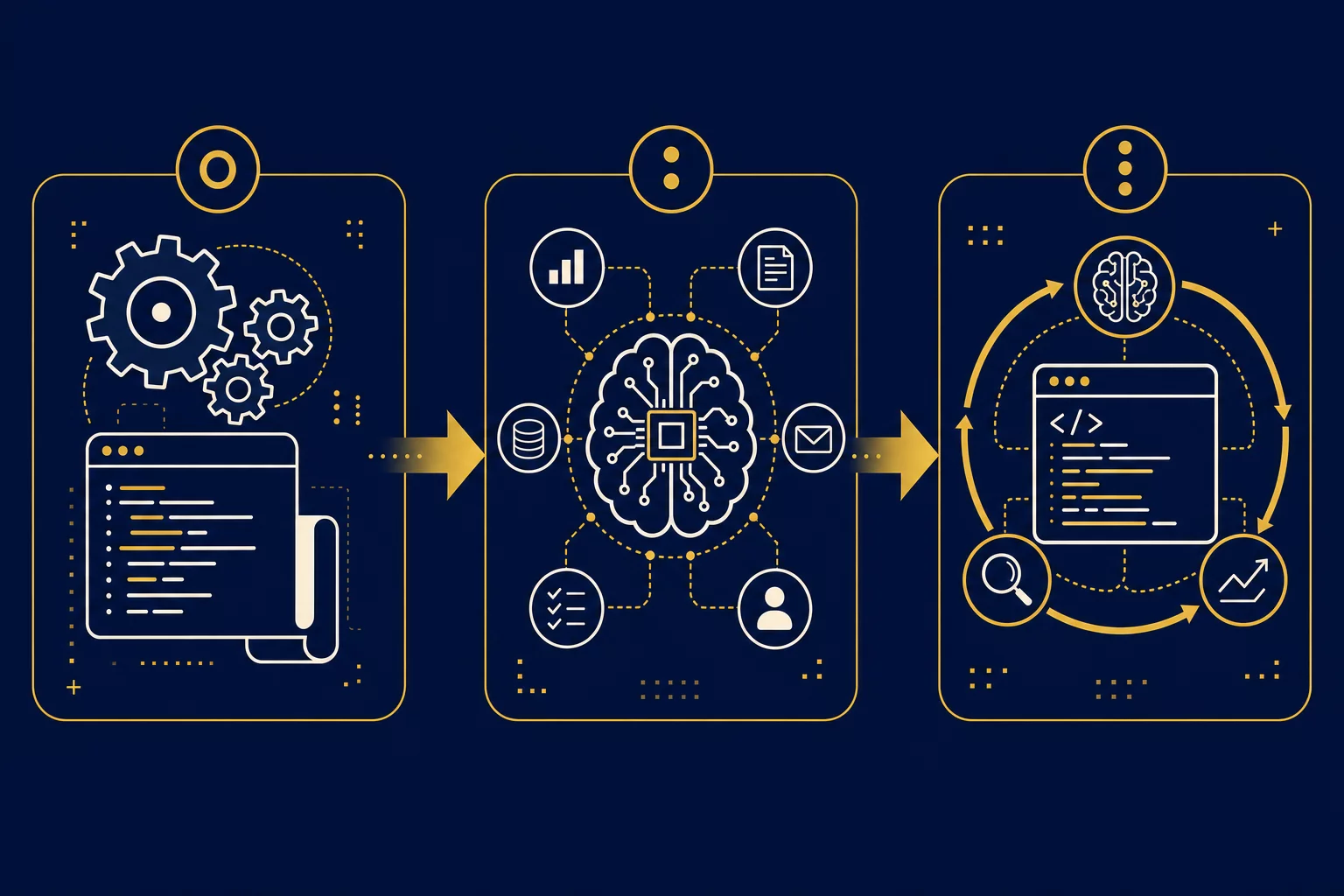
Most companies talk about AI-powered development. We ship with it. Every day. Here’s the progression we’ve lived through — and what comes next.
Stage 1: Automation (Where Most Companies Are)
CI/CD pipelines. Automated tests. Infrastructure as code. The tooling runs deterministic scripts when triggered by human action. A developer pushes code; the pipeline takes over. Useful, but the human is still the bottleneck — the pipeline only runs when a human produces something to test.
Stage 2: Autonomy (Where Avyay Is Now)
Our build engine doesn’t wait for humans. It generates tasks from a product roadmap, assigns them to coding agents running on distributed Mac nodes, verifies the output against quality gates, and deploys. The system makes decisions: which tasks to prioritize, how to resolve dependency conflicts, when to retry vs. escalate to a human.
This is real. Here’s an actual build queue entry from last week:
{
  "task_id": "BUILD-2026-05-12-047",
  "product": "RAKṢĀ",
  "type": "feature",
  "title": "Add SAST rule for hardcoded JWT secrets in env files",
  "priority": 8,
  "generated_by": "autonomous-task-planner",
  "assigned_to": "mac-node-1",
  "dependencies": ["BUILD-2026-05-12-041"],
  "estimated_duration": "35min",
  "actual_duration": "28min",
  "status": "deployed",
  "human_review": "not_required",
  "quality_score": 0.94
}
No human wrote that task. No human assigned it. No human reviewed the code (the quality score exceeded the auto-deploy threshold of 0.90). The only human involvement was defining the product roadmap that the task planner used as input.
Stage 3: Self-Improvement (What We’re Building Next)
The third stage is where it gets genuinely unprecedented. Self-improving systems don’t just execute tasks — they optimize how they execute tasks. They analyze their own failure patterns, modify their own prompts, retrain their own classifiers, and restructure their own architectures.
We’re already seeing early signals. Our build engine tracks which types of tasks fail most often and automatically adjusts its prompting strategy. Tasks that previously failed 30% of the time now fail 8% of the time — not because a human tuned anything, but because the system learned from its own mistakes.
The best way to predict the future is to build it. We chose to take that literally.
The Technology Stack of 2027

Every technology below either exists today in early form or is under active development. The 2027 enterprise stack isn’t speculative — it’s an integration challenge.
1. Self-Modifying Codebases with Confidence Scoring
The codebase of 2027 isn’t static. It evolves. Every change — whether generated by an AI agent or a human — is tagged with a confidence score: a composite metric of test coverage, production stability, performance impact, and historical accuracy of the agent that produced it.
High-confidence changes (score > 0.90) auto-deploy. Medium-confidence changes (0.70–0.90) deploy to canary with automated rollback. Low-confidence changes (< 0.70) are queued for human review.
We already implement this at Avyay. Our quality scoring system evaluates every build output against:
- Test coverage delta: Did the change increase or decrease coverage?
- Static analysis: Any new warnings, security findings, or style violations?
- Behavioral consistency: Do API contracts still hold? Do integration tests pass?
- Performance regression: Did latency or memory usage change significantly?
- Agent track record: How reliable has this agent been on similar tasks historically?
The result: 73% of our code changes deploy without any human seeing them. The remaining 27% are reviewed — and of those, 91% are approved without modification. The system’s judgment is already better than “LGTM” drive-by reviews.
2. AI Product Managers That Analyze User Behavior
Today, a product manager looks at analytics dashboards, talks to users, reads support tickets, and synthesizes all of that into feature priorities. This process takes weeks and is heavily biased by who talks loudest.
The AI product manager of 2027 ingests the same data in real time:
- Usage patterns: Which features are used most? Which are abandoned after first try?
- Support tickets: What are users struggling with? What do they request most?
- Competitive intelligence: What did competitors ship this week?
- Revenue impact: Which features correlate with retention? Which with churn?
- Technical debt: Which areas of the codebase are most fragile? Most expensive to maintain?
From this data, the system generates a continuously updated priority queue of features, improvements, and fixes — each with an estimated business impact score. No quarterly planning needed. The roadmap is alive.
At Avyay, our autonomous task planner already does a simplified version of this. It reads the product roadmap (a structured JSON document), breaks it into implementable tasks, resolves dependencies, and feeds them into the build queue. The next step — making the roadmap itself autonomous — is engineering, not research.
3. Autonomous QA That Prevents Bugs Before They Exist
Traditional QA is reactive. You write code. You write tests. Tests catch bugs. You fix bugs. Ship.
Autonomous QA is predictive. The system analyzes code changes beforethey’re committed and predicts which types of bugs are likely based on:
- Historical bug patterns in similar code changes
- Static analysis of logic complexity and edge cases
- Behavioral simulation against production traffic patterns
- Adversarial fuzzing with AI-generated edge cases
RAKṢĀ, our security scanning product, already operates this way. It doesn’t just scan for known vulnerabilities — it analyzes code patterns that tend to producevulnerabilities and flags them before they become exploitable. In our alpha deployment, RAKṢĀ caught 46 SAST findings and 10 CVEs in AI-generated code before a single line reached production.
4. Economic Models for Feature Prioritization
The most underrated component of the 2027 stack: every feature has a P&L.
Today, feature prioritization is gut-feel wrapped in frameworks (RICE, ICE, MoSCoW). The 2027 system calculates actual economics:
| Input | Metric | Source |
|---|---|---|
| Development cost | Agent compute time × $/hour | Build engine telemetry |
| Revenue impact | Predicted retention Δ × ARPU | ML model on usage data |
| Maintenance cost | Predicted support tickets × $/ticket | Historical complexity correlation |
| Opportunity cost | What else the agent could build instead | Queue analysis |
| Risk | Probability of regression × blast radius | Confidence scoring + dep graph |
The system doesn’t just decide what to build — it decides what’s worth building. Some features are technically trivial but economically pointless. Others are complex but transformative. The economic model makes that distinction automatically, continuously, without a single meeting.
Case Study: Avyay’s Autonomous Pipeline in Action
Theory is cheap. Here’s what actually happened when we let autonomous systems build three production products.
MĀRGĀ — Intelligent LLM Router
MĀRGĀ routes LLM requests across four providers (OpenAI, Anthropic, Google, local Ollama) based on cost, latency, and capability matching. The autonomous build engine:
- Generated 34 tasks from a 2-page product spec
- Built the routing engine, fallback logic, and cost optimization layer in 72 hours
- Achieved 99.97% uptime with auto-failover
- Reduced our LLM API costs by 73%
The cost of development: approximately $47 in compute (agent runtime on Mac nodes). A human team would have taken 2-3 weeks and cost $15,000-$25,000 in salary.
RAKṢĀ — AI Security Scanner
RAKṢĀ scans AI-generated code for security vulnerabilities — SAST findings, CVEs, leaked secrets, insecure configurations. The build engine:
- Built the scanning pipeline, rule engine, and Datadog integration autonomously
- Generated its own test suite including adversarial inputs
- Integrated with the build engine to scan its own output — recursive self-verification
- Ships a security audit report with every build
The most elegant part: RAKṢĀ now scans every code change the build engine produces, including changes to RAKṢĀ itself. The security scanner secures itself. That’s not automation — it’s a self-reinforcing quality loop.
DevOps RAG — Intelligent Incident Response
DevOps RAG makes runbooks queryable via AI-powered retrieval. Instead of searching through docs during a 3 AM incident, engineers ask questions and get step-by-step answers. The build engine:
- Built the RAG pipeline, embedding system, and query interface
- Autonomously generated runbooks from historical incident patterns
- Reduced MTTR from 45 minutes to 15 minutes
- Self-improves: tracks which runbooks resolve incidents successfully and scores them for relevance
The Numbers
Three production-grade AI products. Five days. Two people. $141 in compute. Compare that to the industry standard: a single product would take a team of 8-12 engineers 3-6 months and cost $200,000-$500,000.
We’re not 10x. We’re operating in a different cost structure entirely.
The Human Role in 2027: Strategy, Ethics, and Creative Problem Definition
Let’s address the question everyone’s thinking: what do the humans actually do?
More than you’d expect. Less than they do today.
1. Strategy and Vision
Autonomous systems are extraordinarily good at how. They’re terrible at why. An AI can build a feature in 28 minutes, but it can’t decide whether the feature should exist. It can optimize a metric, but it can’t choose which metric matters.
The CTO of 2027 is a strategist, not an implementer. They define the product vision. They set the constraints. They decide what “good” means for their market. Everything downstream — task generation, implementation, testing, deployment — flows from those strategic decisions, executed autonomously.
At Avyay, the human role is already concentrated here. We spend our time on product strategy, competitive analysis, and customer conversations — not on writing code.
2. Ethical Oversight and Bias Detection
Autonomous systems inherit the biases of their training data, their prompts, and their optimization targets. A system optimizing for engagement will build addictive features. A system optimizing for conversion will build manipulative ones. A system optimizing for efficiency will cut corners on accessibility.
Humans in 2027 are the ethical firewall. They define the constraints that prevent autonomous systems from optimizing their way into harmful outcomes. This isn’t a ceremonial role — it’s the most important one.
3. Creative Problem Definition
The hardest part of building software has never been writing the code. It’s defining the problem correctly. What does the user actually need, as opposed to what they say they want? What’s the simplest solution that solves 80% of use cases? Where should the product not go?
These are fundamentally creative acts. They require empathy, intuition, taste, and judgment — qualities that AI can simulate but not genuinely possess. The humans of 2027 are problem definers, not problem solvers. The solving is automated.
What Most People Miss
The common reaction to autonomous software development is: “AI-generated code is low quality.” This was true in 2023. It’s decreasingly true in 2025. And it misses the point entirely.
The quality ceiling is rising faster than most engineers realize.In January 2025, autonomous agents could handle simple CRUD endpoints. By May 2026, they’re building distributed systems with circuit breakers, retry logic, and observability baked in. The improvement curve isn’t linear — it’s compounding.
Autonomous systems don’t get tired, distracted, or demoralized.The code quality at 3 AM is identical to the code quality at 10 AM. There’s no Friday afternoon effect. There’s no post-standup productivity dip. The output is consistent in a way that human teams physically cannot match.
The economics are asymmetric.A human engineer costs $150,000-$250,000/year. An autonomous build agent on a Mac Mini costs approximately $1,200/year in hardware amortization and $800/year in electricity and compute. The cost difference isn’t 2x or 5x — it’s 75-125x. Even if the autonomous agent is half as productive as a human (it’s not), the economics overwhelmingly favor automation.
The biggest risk isn’t that this technology doesn’t work. It’s that you’re not ready when your competitors adopt it. The companies that figure out autonomous development first will ship faster, cheaper, and with fewer people than everyone else. That advantage compounds.
Common Mistakes and Tradeoffs
We’ve been building autonomous software systems for months. Here’s what goes wrong — and what the tradeoffs actually look like.
Mistake 1: Removing humans entirely too early. Full autonomy requires a foundation of trust built through graduated automation. Start with human-in-the-loop, move to human-on-the-loop (reviewing after deployment), and only then to human-out-of-the-loop for high-confidence changes. We still review 27% of code changes. That number shrinks monthly, but forcing it to zero prematurely creates risk.
Mistake 2: Optimizing for speed without quality gates.An autonomous system can ship bad code faster than any human. Quality gates — test coverage thresholds, security scans, performance benchmarks — are non-negotiable. Our build engine won’t deploy anything with a quality score below 0.70, period. Speed without quality is destruction at scale.
Mistake 3: Treating autonomous development as a tooling upgrade.This isn’t a better CI/CD pipeline. It’s a fundamental restructuring of how software organizations work. It changes job roles, team structures, cost models, and competitive dynamics. Companies that treat it as “we added an AI bot to our workflow” will be outcompeted by companies that restructure around it.
Tradeoff: Control vs. velocity.Every quality gate you add slows the system down. Every gate you remove increases risk. There’s no free lunch — but the optimal balance shifts as your confidence scoring improves. We adjust our thresholds monthly based on false positive and false negative rates.
Tradeoff: Autonomy vs. explainability. The more autonomous the system, the harder it is to explain whyit made a specific decision. We mitigate this with comprehensive logging — every agent decision is recorded with reasoning traces — but the explanations are often post-hoc rationalizations rather than true insight into the model’s decision process.
The Transformation Is Happening Now, Not in 2027
We titled this article “The 2027 Autonomous Enterprise” because that’s when the mainstream will catch up. But the technology is here now. The companies building with it are shipping now. The competitive advantage is accruing now.
Here’s what you can do today:
Step 1: Instrument your development process.You can’t automate what you don’t measure. Track task completion times, code review latency, deployment frequency, failure rates. These metrics become the training data for your autonomous system.
Step 2: Build confidence scoring.Start tagging every code change with automated quality metrics. Test coverage delta. Static analysis results. Performance benchmarks. Over time, you’ll learn which metrics predict production stability — and that becomes your auto-deploy threshold.
Step 3: Automate task generation.Take your product roadmap and build a system that breaks it into implementable tasks with clear success criteria. You don’t need AI for this initially — a well-structured product document and a template system gets you 70% there.
Step 4: Introduce autonomous agents for low-risk tasks.Bug fixes. Documentation. Test generation. Dependency updates. These are the “beachhead” tasks where autonomous agents prove themselves before you trust them with feature development.
Step 5: Graduate to autonomous feature development. Once your confidence scoring is reliable and your quality gates are solid, let the system build features end-to-end. Start with internal tools. Move to customer-facing features as trust builds.
Why Avyay Is Building This
Avyay (अव्यय) means “imperishable” in Sanskrit. We chose the name because we’re building software that doesn’t decay. Software that improves itself. Software that evolves.
Our product suite is the proof of concept:
- MĀRGĀ (The Path) — Intelligent LLM routing that optimizes cost, latency, and reliability across providers. The routing logic improves itself based on production traffic patterns.
- RAKṢĀ (The Shield) — Security scanning that gets smarter with every codebase it analyzes. New vulnerability patterns are learned, not manually added.
- SIDDHI (Intelligence) — DevOps RAG that auto-generates and scores runbooks from incident history. Knowledge that compounds.
- VIDYĀ (Knowledge) — Enterprise knowledge graphs that reason, not just retrieve. Your organization’s collective intelligence, searchable and connected.
- KARMA (Agents) — Autonomous workflow agents that execute multi-step business processes without human orchestration.
Every one of these products was built by the same autonomous pipeline we’re describing. The medium is the message. The build engine that builds the products is itself a product — and it improves with every build.
We don’t sell tools. We sell the future of how software gets built — and we use that future to build itself.
See It for Yourself
We’re opening alpha access to our autonomous development platform. Not a demo. Not a video. Access to the actual system that builds our products.
What you’ll get:
- Live build dashboard: Watch autonomous agents ship code in real time
- Quality metrics: See confidence scores, auto-deploy rates, and failure analysis
- Product demos: Hands-on with MĀRGĀ, RAKṢĀ, and DevOps RAG
- Architecture deep-dive: How we built the build engine that builds itself
The transformation is happening. The question isn’t whether autonomous software development will change your industry. It’s whether you’ll be leading the change or reacting to it.
Gaurav Sharma is the founder of Avyay (अव्यय). He builds autonomous AI systems that ship production software while he sleeps. Follow the build at avyay.ai/blog.